Monday, September 20, 2010

MMG Weekly: Bonds say to China...Yuan-na Piece of Me?

If you can't see the newsletter, or would like to view it online, use this link

If you have received this newsletter indirectly and would like to be added to our weekly distribution list, use this link


Amerifirst Financial


Provided to you Exclusively by Phil Jensen


Phil Jensen
Senior Mortgage Consultant
Amerifirst Financial
Office:
480-682-6613
Cell:
602-692-7445
Fax:
480-374-6987
E-Mail: Phil@JensenTeam.com
Website: www.PhilipJensen.com


Phil Jensen


For the week of Sep 20, 2010 --- Vol. 8, Issue 38

In This Issue

Last Week in Review: Bonds may sink or swim on the value of the Chinese Yuan. Here’s why.

Forecast for the Week: Why are the markets watching the Autumnal Equinox?

View: How to handle fundraisers and donation requests as the new school year starts.

Last Week in Review

"NOT ONLY CAN WATER FLOAT A BOAT - IT CAN SINK IT ALSO." Wise words, but you don’t need to know that Chinese proverb to know that a knife can cut both ways. The same is true with the strong ties between the Chinese and US economies. For example, news came out last week that Chinese factories stepped up production in August, which helped ease concerns of a double-dip recession in US and, as a result, helped move Stocks higher earlier in the week. But additional news regarding China is also impacting the Bond market - and could impact home loan rates in the future, depending on how the events unfold.

Here’s what’s happening. There have been numerous accusations that China has kept their currency artificially low, in an effort to fuel their exports. Some American businesses remark that this is an unfair competitive advantage, and call for tariffs to be levied against Chinese goods. It would appear that a stronger Chinese Yuan would help to resolve this problem... but remember there can be some nasty unintended consequences, due to the relationship between Chinese currency and our Bond prices. The way that the Chinese keep their currency weak against the Dollar is by buying massive amounts of our Bonds, including Mortgage Backed Securities. And their heavy buying has helped keep home loan rates low. So strengthening the Yuan would require fewer purchases of our Bonds and Mortgage Backed Securities - and that would be negative for home loan rates.

To paraphrase the Chinese proverb above, the value of the Chinese Yuan may help determine whether Bonds sink or swim in the near future. That makes this a complicated situation... but you can count on me to continue to monitor it closely.


-----------------------

The Chinese Yuan May Help Bonds Sink or Swim

Bonds saw a nice rally earlier last week, due to speculation about the Fed making additional purchases of Bonds in the future. Last week, Goldman Sachs said the Fed may announce another $1 Trillion asset purchase at the November meeting. And while this is just speculation, many Bond traders bid prices higher on the chatter. Adding fuel to this story was an article in the Wall Street Journal, suggesting the same thing. On the other side of the debate, however, is Richmond Fed President Jeffrey Lacker, who stated that the US is far from needing more Bond purchasing by the Fed.

In other economic news, the Labor Department reported the inflation measuring Consumer Price Index (CPI) for August at 0.3%. That reading was just slightly above the 0.2% that was expected, but it was still a relatively tame reading. When stripping out volatile food and fuel, Core CPI was flat at 0.0%. This rather benign read on inflation allowed traders to breathe a sigh of relief and push Bonds higher. Prior to receiving the news, many traders were worried the CPI reading would be higher than expected. That’s because the Producer Price Index (PPI) was reported the day before and showed wholesale inflation rose by 0.4% in August. That was above the 0.3% expected and the biggest gain in 5 months! Remember, inflation is the archenemy of Bonds and home loan rates, so any indication that inflation is increasing could cause home loan rates to worsen.

IT’S THAT TIME OF YEAR AGAIN! THE START OF THE NEW SCHOOL YEAR MEANS THE BEGINNING OF SCHOOL FUNDRAISERS AND DONATION REQUESTS. ALTHOUGH THE INTENTIONS ARE GOOD, THEY CAN BE TOUGH ON YOUR BUDGET. FOR TIPS ON HOW TO HANDLE ALL THOSE REQUESTS, CHECK OUT THE MORTGAGE MARKET GUIDE VIEW BELOW.

Forecast for the Week

The seasons are changing... but watching the calendar can also help us prepare for changes in the market, especially with Stocks now nearing a very important trading date. September 22 - which is the day of the Autumnal Equinox - has often marked an apex and turning point lower for market prices and events. Keep this in mind as we approach this date this Wednesday, especially with Stocks trading near tough technical resistance. If this trend holds, Stocks may head lower and help Bonds and home loan rates improve. But since traders are aware of this potential problem period for Stocks, an avoidance of the trend would likely have Stocks’ players move into the Stock market with more gusto towards the end of next week, prompting a Bond sell off.

The Fed will hold their Federal Open Market Committee (FOMC) meeting next Tuesday - and always, the markets will be listening closely when the Fed’s Monetary Policy and Rate Decision are announced.

Also on tap for next week are new reports on the health of the housing industry, beginning with Housing Starts and Building Permits for August on Tuesday. We’ll also see reports on Existing Home Sales on Thursday and New Home Sales on Friday.

Thursday brings another round of Initial Jobless Claims. Last week, the Labor Department reported Initial Jobless Claims fell to 450,000, below estimates of 460,000 and the lowest reading in two months. While 450,000 claims are still a pretty high number, it is improved from recent readings.

Finally, we’ll get a look at manufacturing on Friday with a new report on Durable Goods Orders for August. Durable Goods Orders are considered a leading indicator of manufacturing activity, and the market often moves on this report despite the volatility and large revisions that make it a less than perfect indicator.

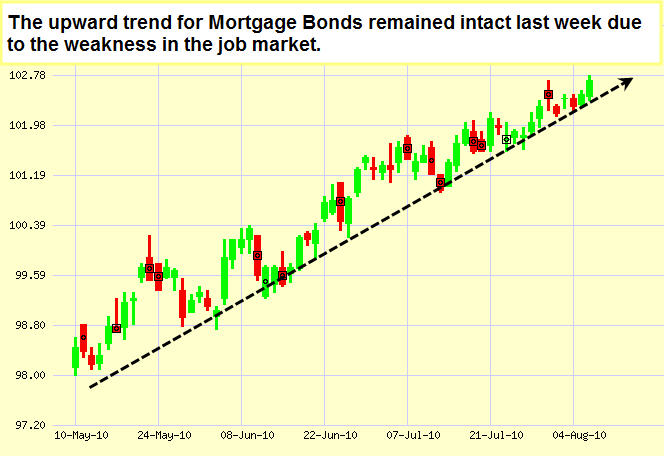
Remember: Weak economic news normally causes money to flow out of Stocks and into Bonds, helping Bonds and home loan rates improve, while strong economic news normally has the opposite result. As you can see from the chart below, Mortgage Bonds have started to step down after climbing to a record high at the end of August. Overall, Bonds and home loan rates ended the week worse than where they began.

The good news is home loan rates are still at historically great levels for homebuyers or homeowners looking to refinance... but that situation won’t last forever.


-----------------------

Chart: Fannie Mae 3.5% Mortgage Bond (Friday, September 17, 2010)

The Mortgage Market Guide View...

When Your Child's School Asks You to Give, Give, Give

Here's how to handle all those requests for classroom supplies, fundraiser contributions and more.

By Cameron Huddleston, Kiplinger.com

Parents, I know you're feeling the pull on your purse strings from you children's schools. You're being asked to contribute supplies to your children's classrooms (not just pencils and paper, but even cleaning supplies). You're expected to donate money to help with the schools' fundraisers. You're getting notes from teachers each week about this field trip or that art project you have to pay for if your children want to participate.

I know because I'm a parent with one child in a public school and one child in a private preschool. As president of the parent committee at one of my children's schools and vice-president of the parent-teacher organization at the other, I also know how much the schools need financial support from parents. So how do you balance your desire to help with the reality of your own limited funds -- and avoid looking like a cheapskate if you can't open your wallet every time the school asks?

Even though this is your child and his school we're talking about, you have to approach this like you would any other financial situation. You have to...

Set a budget. If this is your child's first year in school, talk to his or teacher, parents with older children or members of the parent organization to get an idea of how much you'll be expected to spend on supplies, field trips, etc. or to contribute to fundraisers throughout the year. If your child is a returning student, you already have a pretty good idea. Once you have a dollar amount, it will be easier to figure out whether you can make room in your budget to help out your child's school. Our budget worksheet can help.

Prioritize. Of course the school, its parent committee and your child's teacher would love for you to donate every time they ask, but they also understand that not every parent can. So contribute only when it fits in your budget and when you feel like your contribution will have the most impact. That might mean skipping the chili-supper raffle in order to buy a coffee mug adorned with your child's art so his or her feelings don't get hurt.

Give your time. You might not be able to afford monetary contributions, but you can donate your time. Schools need volunteers to help in the classroom, cafeteria, you name it.

Reprinted with permission. All Contents ©2010 The Kiplinger Washington Editors. www.kiplinger.com.


--------------------------

Economic Calendar for the Week of September 20-24, 2010

Remember, as a general rule, weaker than expected economic data is good for rates, while positive data causes rates to rise.

Economic Calendar for the Week of September 20 - September 24

Date

ET

Economic Report

For

Estimate

Actual

Prior

Impact

Tue. September 21

08:30

Housing Starts

Aug

550K


546K

Moderate

Tue. September 21

08:30

Building Permits

Aug

555K


559K

Moderate

Tue. September 21

02:15

FOMC Meeting

Posted via email from philipjensen's posterous

Tuesday, September 7, 2010

Special Holiday Article

Phil Jensen

Mortgage Director

AmeriFirst Financial

Phone: 602-692-7445

Fax::

Phil@JensenTeam.com

www.JensenTeam.com


Labor Day Holiday  


I hope you and your family enjoyed the Labor Day holiday. And, I sincerely hope you have been enjoying your complimentary subscription to the MORTGAGE MARKET GUIDE WEEKLY.

Due to the holiday weekend, the next full issue will arrive on Monday, September 13. In the meantime, check out the special article below from Kiplinger.com with great money management lessons for kids of all ages. This is a great article that can be shared with your family, friends, and associates as we celebrate this unique holiday, so please feel free to forward this email on to them.

I am pleased to provide this timely article to you as well as weekly insights into the mortgage and housing industries through the MORTGAGE MARKET GUIDE WEEKLY. If you feel that any of your clients, friends, family members, or associates would benefit from keeping up to date on market and economic trends in this easy-to-read format, please let me know, and I will be more than happy to add them free of charge.

Best wishes to you this holiday weekend. And remember, if you need any assistance at this time, just give me a call.


The Mortgage Market Guide View...  


Advice for Parents as Their Kids Head Back to School

Now is a great time to teach your children lessons about managing money. Here's how.

By Janet Bodnar, Kiplinger.com

One positive outcome of the financial turmoil over the past couple of years is that parents and kids are talking more frequently about financial issues. In the T. Rowe Price Parents, Kids & Money survey released earlier this year, nearly half of the parents interviewed said they are having more conversations with their children about money and the basics of saving versus spending.

And, yes, Mom and Dad, your children are willing to listen. In fact, 65% of kids said they had approached their parents to talk about money issues.

Unfortunately, the lessons don't always stick. For instance, a majority of kids who get an allowance sometimes spend it all at once and many of them come back for more. As students head back to school, parents have a golden opportunity to take advantage of a prime teachable moment for kids of all ages.

Elementary and middle-school students: Start an allowance. When children enter first grade, they learn that four quarters equal ten dimes equal one dollar, and they have a more sophisticated understanding of just how far money will go and how to parcel it out.

Start with a basic weekly allowance equal to half a child's age. You can adjust that up or down, depending on how much you expect your kids to pay for.

Unless you're very well organized, I don't recommend that you tie the basic allowance to household chores. It's tough to keep track of what the kids have done (or not done). And they should be doing some tasks without pay to lend a helping hand.

Instead, give the kids financial "chores," such as paying for their own collectibles or refreshments at the movies. Giving youngsters a fixed amount of money - and certain responsibilities to go along with it - teaches them how to make choices, and makes it less likely that they'll spend it all at once and come back for more.

To teach kids the value of being paid for their labors, you can pay for extra household tasks on a job-by-job basis. That also makes it easier for you and the kids to keep tabs on what they've done.

As children enter middle school, you can expand their allowance - and their responsibilities - to include other expenses, such as mall excursions, after-school snacks with friends and movie tickets.

High school students: The average American family will spend more than $600 on clothes, shoes, school supplies and electronics, reports the National Retail Federation, so the back-to-school shopping season is a great time to introduce a clothing allowance. Nothing will focus your teen's attention on wants versus needs more than having to fill out her wardrobe on a fixed income.

Mining her closet for things that are still wearable is a good first step. Then she can decide whether she really wants to splurge on a single pair of Juicy Couture denim leggings for $128 or get a couple of pairs from Old Navy for $34.50 each - and still have money for new tops.

This is also a good time to help your kids set up a checking account, especially if they have earnings from a summer job. Community banks and credit unions may be more customer-friendly to teens than big banks. If your bank balks, you can always cosign for the account.

Another alternative is to give kids access to their savings account with an ATM card so that they can make deposits and withdrawals. The point is to give them more freedom (and responsibility) to manage their account, and avoid overdrafts, before they head off to college.

College students: It often comes as a surprise to parents and kids that they don't agree on who's going to pay for which expenses. And it's an even bigger shock when the bills start rolling in a month or two into the semester. So cover all the bases before you drop your kids at the dorm.

Let your kids know, for example, that you'll pay for textbooks, but to lower the cost they should look into campus book exchanges, discount Web sites, book rentals and digital books (see How to Cut Textbook Costs in Half - or More).

You'll pay for the school meal plan, but beer and pizza on Saturday nights are on their tab. And tell your kids that they'll have to share discretionary expenses, such as Greek fees, so they should think twice before pledging.

New laws covering bank overdraft fees and credit cards for young adults hit college students squarely in the wallet. For advice on how to handle those situations, see 5 Financial Lessons for College Students.

Reprinted with permission. All Contents c2010 The Kiplinger Washington Editors. www.kiplinger.com.


--------------------------

Economic Calendar for the Week of September 6-10, 2010

Remember, as a general rule, weaker than expected economic data is good for rates, while positive data causes rates to rise.

Economic Calendar for the Week of September 06 - September 10

Date

ET

Economic Report

For

Estimate

Actual

Prior

Impact

Wed. September 08

10:30

Crude Inventories

9/04

NA


3.42M

Moderate

Wed. September 08

02:00

Beige Book

Sept


Moderate

Thu. September 09

08:30

Jobless Claims (Initial)

9/04

NA


472K

Posted via email from philipjensen's posterous

Monday, August 23, 2010

Mortgage week in review


Amerifirst Financial


Provided to you Exclusively by Phil Jensen


Phil Jensen
Senior Mortgage Consultant
Amerifirst Financial
Office:
480-682-6613
Cell:
602-692-7445
Fax:
480-374-6987
E-Mail: Phil@JensenTeam.com
Website: www.PhilipJensen.com


Phil Jensen


For the week of Aug 23, 2010 --- Vol. 8, Issue 34

In This Issue

Last Week in Review: Change is needed in the housing and job markets. Find out what kind... and how will those steps impact home loan rates?

Forecast for the Week: We’ll get reads on the housing market and the economy this week, but what direction will the reports show?

View: It may take two credit reports to make a closing go right. Find out why in this week’s View.

Last Week in Review

"There is nothing wrong with change, if it is in the right direction." Winston Churchill. And certainly, seeing our economy improve is change in the right direction. But what steps will get us there... and how will those steps impact home loan rates. Here’s what you need to know.

Last Tuesday, the government held a "Future of Housing Finance" conference to discuss changes needed in this area. Most participants agreed that government assistance for housing must be reduced but not eliminated. Bill Gross, from PIMCO and one of the panelists, called for a massive refinancing of certain mortgages backed by Fannie/Freddie/FHA, believing such a move would lift home prices 5% to 10% and provide a $50 Billion stimulus to the economy. I will be watching this situation closely for further developments.

Home sales and the job market - two key aspects to our continued recovery - are also areas we need to see change in an improving direction. Last week, the NAHB Housing Market Index came in a bit worse than expectations and showed housing to be at a 17-month low. It can be argued that the tax credits actually hurt the housing market by not adding any sales, just pushing them up. This has now resulted in a void or softer period in the market, potentially wasting billions of dollars. Housing Starts and Building Permits were also reported lower than expected last week. Clearly, demand for housing has slowed over the past few months, due to the expiration of the Home Buyer Tax Credit and persistently high unemployment.

Speaking of unemployment, awful is the only way to describe last week’s Initial Jobless Claims report. According to the report, 500,000 people filed to receive unemployment benefits for the first time, which was well higher than the lofty 475,000 expected and the highest reading since November 2009. In addition, between Continuing Claims and people receiving Emergency Unemployment Compensation or EUC, the combined total of people receiving unemployment benefits now equals 9.25 Million people.

The bottom line is this: The labor market is the foundation of our economy. Job growth and confidence is the best and most sustainable way for our economy to recover. The present anti-business regulatory environment is pushing Initial Claims, a leading indicator on the health of the labor market, in the wrong direction.

But home loan rates, meanwhile, continue to remain at historic low levels. Though keep in mind, inflation is the arch enemy of Bonds and home loan rates, which means it can cause both to worsen. Both the Producer Price Index (which measures inflation at the wholesale level) and the Consumer Price Index were recently reported hotter than expected. If rates do start to rise, they will likely do so quickly.

If you or anyone you know would like to learn more about taking advantage of historically low home loan rates, please don’t hesitate to call or email. Or forward this newsletter on to anyone you think may benefit and I’d be happy to talk to them free of charge.

WHEN YOU’RE BUYING A HOUSE, THE LAST THING YOU WANT IS AN UNSUCCESSFUL CLOSING. CHECK OUT THE MORTGAGE MARKET GUIDE VIEW FOR SOME INFORMATION THAT WILL HELP ENSURE YOUR HOMEBUYING EXPERIENCE MOVES IN THE RIGHT DIRECTION.

Forecast for the Week

More housing and job news follows this week, but will there be change in an improving direction? We’ll find out with Tuesday’s Existing Home Sales Report, Wednesday’s New Home Sales Report, and Thursday’s Initial and Continuing Jobless Claims Report.

Also, on Wednesday we'll get a read on the health of the economy with the Durable Goods Report, which gives us an update on consumer and business buying behavior on big-ticket items that last for an extended period of time. Meanwhile, Friday will bring another read on the economy with the Gross Domestic Product Report, which is the broadest measure of economic activity.

Remember: Weak economic news normally causes money to flow out of Stocks and into Bonds, helping Bonds and home loan rates improve, while strong economic news normally has the opposite result.

As you can see in the chart below, last week’s weak economic news helped home loan rates hit record lows again, but volatility was rampant. I’ll be watching closely to see what this week brings.


-----------------------

Chart: Fannie Mae 3.5% Mortgage Bond (Friday, August 20, 2010)

The Mortgage Market Guide View...

Credit Reports: One May Not Be Enough

This summer, Fannie Mae instructed lenders that they should adopt a new policy that would include a second review of an applicant's credit report just prior to closing. Why? The answer is simple: the credit profile of a borrower may have changed between the time of the initial review of the credit report and the time of closing.

How will this impact the home loan?

The potential impact to a borrower who has utilized credit to make significant purchases after the initial credit report could include:

  • A delay in closing
  • Increase of closing costs and/or interest rate
  • A decreased loan amount
  • Denial of the loan

That’s right, in the worst-case scenario, a change in credit could even result in a loan being denied - even after an original approval had been granted.

What should homebuyers do (or not do)?

In order to eliminate any possibility of potential problems before closing, anyone in the application process should use credit sparingly and make sure they adhere to the tips provided below by credit expert Linda Ferrari of Credit Resource Corp:

  • Don't do anything that causes a red flag to be raised by the scoring system.
  • Don't apply for new credit of any kind.
  • Don't pay off collections or charge offs.
  • Don't max out or over charge on your credit accounts.
  • Don't consolidate debt onto one or two credit cards.

This list is not comprehensive, but it does give you a peek into situations that could create issues and could also be contrary to some ideas you have read previously.

--------------------------

Economic Calendar for the Week of August 23-27, 2010

Remember, as a general rule, weaker than expected economic data is good for rates, while positive data causes rates to rise.

Economic Calendar for the Week of August 23 - August 27

Date

ET

Economic Report

For

Estimate

Actual

Prior

Impact

Tue. August 24

10:00

Existing Home Sales

Jul

4.75M


5.37M

Moderate

Wed. August 25

08:30

Durable Goods Orders

Jul

3.1%


-1.2%

Moderate

Wed. August 25

10:00

New Home Sales

Jul

330K


330K

Moderate

Wed. August 25

10:30

Crude Inventories

8/21

NA


-0.818M

Moderate

Thu. August 26

Posted via email from philipjensen's posterous

Monday, August 9, 2010

MMG Monthly - Views You Can Use


Provided to you Exclusively by Phil Jensen

Phil Jensen

Phil Jensen
Senior Mortgage Consultant
Amerifirst Financial
Office: 480-682-6613
Mobile: 602-692-7445
Fax: 480-374-6987
Email: Phil@JensenTeam.com
Website: www.Philip.Jensen.com


Amerifirst Financial

For the Month of August 2010 --- Vol. 5, Issue 8


IN THIS ISSUE...  


What's in a name? This month's edition is all about names. For instance, the Financial Reform bill was recently signed into law. But does this new law really reform the financial system, as the term suggests? The first article below provides a brief overview of the changes in the law. You'll also find two articles below that can help you remember names of people you meet, while protecting your own good name from identity theft!

  • Ch-ch-ch-ch-changes - Are the new Financial Reform changes really worth singing about?
  • It pays to have a good memory - Give your networking or job search a boost with these techniques.
  • Q&A: Identity protection? - Follow these simple steps to make sure your identity is protected!

If you have any questions or need any help at this time, just call or email to discuss your unique situation. And, please forward this newsletter to friends, family members and coworkers who may find the information helpful.


Are Financial Reform ch-ch-ch-ch-Changes Worth Singing About?  


They say the only constant is change... and more change is coming! Last month, the sweeping Financial Regulation Bill was signed into law and promises to bring a wave of new changes to the financial system. But the question is: what does this change mean to you? Here's what you need to know.

Generally speaking, the law calls for a new consumer protection agency and prohibits banks from taking risky bets. While those things are important, it's also important to realize that this legislation... over 2,000 pages worth... amazingly does nothing to address the core reasons for the financial collapse. Fannie Mae and Freddie Mac are completely left out of this legislation. Additionally, the credit rating agencies - which may have played the largest role in the financial collapse - also go unmentioned.

In fact, when former Fed Chairman Alan Greenspan was asked about Financial Regulation, he noted that this was the first time the Fed was not asked to write a regulation of this kind. He also said that there are "unintended consequences" in every page of this bill.

And one consequence we've seen already is that corporations are hoarding cash, and are somewhat stuck like a deer in the headlights due to the uncertainty that this and other pending legislation is creating. And when corporations hoard cash, they don't typically hire workers, and job creation is crucial to our recovery.

What all this will mean for our economy and home loan rates remains to be seen... which is why now is the perfect time to act, while home loan rates continue to be some of the best they have ever been! If you or anyone you know would like to learn more about this exceptional opportunity, please don't hesitate to call or email. Or forward this newsletter on to anyone you think may benefit and I'd be happy to talk to them free of charge.


It Pays to Have a Good Memory  


In today's tough job market, it can pay (quite literally) to have a good memory. That's because a good memory can help you stand out from the competition - whether you're networking and trying to remember names or researching a potential employer and trying to remember specific points.

Unfortunately, many of us have trouble remembering the name of someone two minutes after we shake her hand. If that sounds like you, don't worry. you're not alone. It's actually an extremely common occurrence for many people. The good news is there is plenty of research on the subject and there are a number of simple, practical steps you can take to improve your memory now and long into the future.

With that in mind, here are a couple of great tips for proactively strengthening your memory:

Tip #1: Neurobic Exercise

You know all about the wonderful effects aerobic exercise has on the heart, but have you heard of neurobic exercise for the brain?

According to Lawrence Katz, co-author of Keep Your Brain Alive: 83 Neurobic Exercises, the best exercise for the brain is to force it to form "new patterns of association" or new pathways. In other words, challenge your brain every day. take it off autopilot and make it relearn or create new associations with the most routine activities of your day.

Katz's book offers numerous examples of small changes you can make to activate your brain, including: brushing your teeth with the other hand; taking an alternative route to work; moving your wastebasket to the other side of your desk; closing your eyes while putting your key in and unlocking the front door; and changing where you and your family members sit at the dinner table.

So if you feel like your memory might be starting to slip a bit, try some of these simple neurobic exercises today!

Tip #2: Mnemonic Drilling

There are actually three steps or stages of memorization: acquisition, consolidation, and retrieval. That means, once we acquire new information, like someone's name for instance, the way in which we consolidate that data will directly affect how well we're able to retrieve it from memory.

Whether you're a visual or auditory type of learner, there are many mnemonic devices that can help you to better organize or consolidate the new information that you need to recall.

Here's an example of simple steps that might help:

First, associate the data you want to remember with common images. For instance, let's say you meet someone named Jennifer Green. Imagine Jennifer playing golf, or picture her wearing all green clothes, or imagine her face painted completely green.

Second, think of associations you can use to help you remember this person. For instance, link Jennifer to the quality that best fits her personality (use alliteration and rhymes whenever possible): Jolly Jennifer Green.

Finally, connect sound to your memory by saying the name aloud.

Do this regularly and, before you know it, you'll never forget anyone's name again! And that can give you a nice advantage in job interviews and networking.


Q&A: Identity Protection?  


QUESTION: How can you protect yourself from identity theft?

ANSWER: According to statistics released by the U.S. Department of Justice, about 1.6 million households experience theft of existing accounts other than a credit card (such as a banking account), and 1.1 million households discover misuse of personal information (such as their social security number) annually. Here are some important tips for keeping your information safe and sound:

Just the facts - Rather than give unnecessary information (like your date of birth and income level) when you fill out things like warranty cards or supermarket club cards, start sharing only what's really necessary in every situation.

Navigating the net - Never post your address or your full date of birth on any social networking sites because both are pieces of information needed to steal your identity. Also, when applying for a job, thoroughly investigate companies before you submit your resume and check the privacy policies of any online job boards to make sure they won't sell your information.

Number no-nos - Never keep your Social Security number in your wallet, glove compartment, or any other easy-to-access place. Also, never have it printed on your checks or use it as your password. Finally, if you use an online job site, never give a potential employer your Social Security number until they are ready to hire you.

Shed it - When you are ready to get rid of old documents that contain important information, make sure you shred them.

The bottom line is this: When it comes to your personal information, share it on a need-to-know basis only!


.

Equal Housing Lender          


NOTE: THIS IS A CONFIDENTIAL AND PRIVILEGED COMMUNICATION. This transmission is intended only for use by the individuals or entities to which it is addressed, and contains confidential and/or privileged information. If the reader of this message is not the intended recipient, or the employee or agent responsible for delivering the message to the intended recipient, you are hereby notified that any dissemination, distribution or copying of this communication is strictly prohibited. If you have received this communication in error, please send a reply to us and permanently delete the e-mail from your computer.

Posted via email from philipjensen's posterous

Sunday, August 8, 2010

Fw: MMG Weekly: Economy 'Laboring' Towards Recovery

Sent from my Verizon Wireless BlackBerry

________________________________
From: MMGW
Date: Sun, 8 Aug 2010 09:38:40 -0700
To: Phil Jensen
Subject: MMG Weekly: Economy 'Laboring' Towards Recovery

If you can't see the newsletter, or would like to view it online, use this link If you have received this newsletter indirectly and would like to be added to our weekly distribution list, use this link
[http://www.mmgweekly.com/admin/images/mmg_logo.gif]
[http://www.mmgweekly.com/templates/images/weekly/banner_weekly_Blue.jpg]


[http://www.mmgweekly.com/member/32989/images/jensen-amerifirst.gif-final.gif]

Provided to you Exclusively by Phil Jensen

Phil Jensen
Senior Mortgage Consultant
Amerifirst Financial
Office: 480-682-6613
Cell: 602-692-7445
Fax: 480-374-6987
E-Mail: Phil@JensenTeam.com
Website: www.PhilipJensen.com

[http://www.mmgweekly.com/member/32989/images/philip-jensen-photo.gif-finallll...]


For the week of Aug 09, 2010 --- Vol. 8, Issue 32

In This Issue


Last Week in Review: The important Jobs Report numbers are in... survey says? Get all the details below.

Forecast for the Week: More inflation news is ahead, plus the Fed is meeting. Will they shake up the markets?

View: Web cam interviews are growing in popularity these days. Learn tips for acing one!


Last Week in Review


WORKIN' NINE TO FIVE... WHAT A WAY TO MAKE A LIVIN'..." Dolly Parton. But unfortunately, last week's Jobs Report was worse than expected, showing more and more people aren't workin' nine to five or any other kind of full time job. So what does this mean for our economy and home loan rates? Read on to find out.

[http://www.mmgweekly.com/templates/mmgweekly/spe_chart/Top_Chart_8_9_10.jpg]Last Friday's Jobs Report showed that 131,000 jobs were lost for the private and government sectors, versus the 87,000 job losses expected. To add insult to injury, the revisions for June showed nearly 100,000 more jobs lost than had been previously reported. While some of the losses were due to the government laying off temporary census workers, the private sector was also disappointing, showing 71,000 job creations for July, worse than expectations of 83,000... and well short of the market's hope of 100,000. Rounding out the report, the Unemployment Rate remained steady at 9.5%, just below the 9.6% anticipated.

In addition, something to keep in mind is that the State governments are now under major pressure because of growing budget deficits. With tax revenues declining and budget cuts needed, States are finally having to make cuts like the private sector already has. As they start to catch up in making cut-backs to headcount, this could cause the unemployment rate to worsen. Not very good news, as an improvement in the labor market is needed to fuel the economic recovery... and especially disappointing, considering the money that has been injected to try and remedy this situation.

Also in the news, the Commerce Department reported last week that Personal Spending and Incomes were unchanged in June, due to a slowing of the economic recovery in the spring. In addition, the Savings Rate increased as consumers cut back on spending.

Why is all this significant... and what does it have to do with interest rates? It has to do with something called the velocity of money. Even though the government keeps pumping money into the system, nothing happens until that money is spent or lent, and passes from one hand to another, or one business to another. The speed at which this money passes between parties is called the velocity of money. With the job market still very sluggish, consumers aren't spending much money these days... and businesses are still reluctant to spend money making investments in their business. With present velocity at low levels, inflation remains subdued... however, once velocity increases, the excess money in the system will cause inflation.

And remember, inflation is the arch enemy of Bonds and home loan rates... which means that even the scent of inflation can cause home loan rates to worsen.

While we certainly want to see better Jobs Report numbers in the future, Bonds and home loan rates were able to benefit from the poor report. Remember, weak economic news often causes money to flow from Stocks to Bonds as traders seek to protect their investments in the safer haven of Bonds. As a result, Bonds and home loan rates ended the week slightly better than where they began.

If you or anyone you know would like to learn more about taking advantage of historically low home loan rates, please don't hesitate to call or email. Or forward this newsletter on to anyone you think may benefit and I'd be happy to talk to them free of charge.

ACING A JOB INTERVIEW IS ESPECIALLY IMPORTANT IN TODAY’S TOUGH JOB MARKET. CHECK OUT THE MORTGAGE MARKET GUIDE VIEW FOR SOME TIPS ON HAVING A GREAT WEB CAM INTERVIEW.


Forecast for the Week


There will be plenty of action ahead this week, beginning with Tuesday's Federal Open Market Committee meeting. This week's meeting will be very important and closely watched as the important "extended period" language will come under scrutiny, as well as options that the Fed will discuss to further stimulate the economy and avoid deflation. Their decisions could certainly impact home loan rates, and I will be watching closely to see what happens.

Also this week, Thursday brings another Initial and Continuing Jobless Claims Report, while on Friday we will see both the Retail Sales and Consumer Price Index (CPI) Reports. Remember, last week it was reported that Personal Savings increased, so it will be important to see how this impacts Retail Sales. And, as mentioned above, any hint of inflation can hurt Bonds and home loan rates, which is why the CPI Report - which measures inflation at the consumer level - is also an important one to watch.

Remember: Weak economic news normally causes money to flow out of Stocks and into Bonds, helping Bonds and home loan rates improve, while strong economic news normally has the opposite result.

As you can see in the chart below, Bonds and home loan rates continue to improve, most recently aided by the weak Jobs Report.

-----------------------

Chart: Fannie Mae 4.0% Mortgage Bond (Friday, August 6, 2010)

[http://www.mmgweekly.com/templates/mmgweekly/reg_chart/258/images/Weekly_Char...]
The Mortgage Market Guide View...


How to Succeed on Webcam Interviews

Webcams have steadily grown in popularity in households across the country. Now, companies are embracing the technology as a cost-effective, timesaving way to conduct interviews. And businesses aren’t the only ones turning to this technology. Colleges and universities - such as the University of Georgia, Pennsylvania State University, Arizona State University, and Wake Forest - are also using the technology to interview applicants before admitting them.

If you or someone you know is in the process of applying for a new job or to a university, the following information can help you put your best foot forward if you’re asked to participate in a webcam interview.

Eliminate distractions. When you’re on a webcam at your house, you can be interrupted by the phone ringing, the kids playing, or the doorbell ringing. To make sure that doesn’t happen, find a quiet place where you can avoid any distractions that may compromise your interview.

Remove the clutter. A webcam interview doesn’t just allow the company to see you; they can also see into your home. If the background setting looks messy, cluttered, or less than professional, it may taint the company’s perception of you. So, clean up everything that will be in the background, including those things that are off in the distance. The best advice is to have a clean, simple background setting for the interview where only one or two major pieces of furniture can be seen.

Dress for success from top to toe. While it may be tempting to dress professionally from the waist up while wearing shorts or pajamas below, don’t do it. There are too many stories of people who found themselves reaching for a book or retrieving an object during the interview, only to be embarrassed by the lack of professional attire on their legs. And while the situation may sound laughable, the company interviewing you may take it as a sign that you’re either trying to get away with something or that you’re the type of person who does things halfway.

Check the lighting. Anyone who’s ever used a webcam realizes that you can sometimes appear pale or tired in an online video. To overcome this problem, you can take a few simple steps. First, make sure you are well rested before the interview. Second, check the lighting. You’ll want the room to be bright, but not so bright that your face is washed out. If you need additional lighting, bring a lamp or two into the room.

Maintain eye contact. To make sure you maintain eye contact, look directly at your webcam - rather than at the person’s image on your monitor. It may feel awkward at first, but it will appear natural and professional to the person on the other end.

Test your equipment. No matter how familiar you are with a webcam, you should arrive at your desk well before the interview and test your equipment. You may even want to consider video chatting with a friend for a few minutes.

Send the right body language. Like a face-to-face interview, your posture and body language are important online. So sit up straight, use simple hand gestures as you talk, and resist the urge to fidget or make a lot of unnecessary movements (like scratching your head or constantly readjusting your seating position).

Be specific, yet concise. Provide concise answers that convey specific details. Prepare specific talking points and details about your accomplishments, and then practice saying them succinctly. But don’t memorize a script like you would a speech. Instead, focus on working some talking points into different types of answers.

Finally, don’t be put off by a short silence after you finish speaking, which is likely due to the time delay. Remain confident and stick to your concise statements.

--------------------------

Economic Calendar for the Week of August 9-13, 2010

Remember, as a general rule, weaker than expected economic data is good for rates, while positive data causes rates to rise.

Economic Calendar for the Week of August 09 - August 13

Date

ET

Economic Report

For

Estimate

Actual

Prior

Impact

Tue. August 10
08:30
Productivity
Q2

0.1%

2.8%

Moderate

Tue. August 10
02:15
FOMC Meeting
8/10

0.25%

0.25%

HIGH

Wed. August 11
08:30
Balance of Trade
Jun

-$42.5B

-$42.3B

Moderate

Thu. August 12
08:30
Jobless Claims (Initial)
8/07

465K

479K

Moderate

Fri. August 13
08:30
Consumer Price Index (CPI)
Jul

0.2%

-0.1%

HIGH

Fri. August 13
08:30
Core Consumer Price Index (CPI)
Jul

0.1%

0.2%

HIGH

Fri. August 13
08:30
Retail Sales
Jul

0.5%

-0.5%

HIGH

Fri. August 13
08:30
Retail Sales ex-auto
Jul

0.2%

-0.1%

HIGH

Fri. August 13
10:00
Consumer Sentiment Index (UoM)
Aug

70.0

67.8

Moderate


The material contained in this newsletter is provided by a third party to real estate, financial services and other professionals only for their use and the use of their clients. The material provided is for informational and educational purposes only and should not be construed as investment and/or mortgage advice. Although the material is deemed to be accurate and reliable, we do not make any representations as to its accuracy or completeness and as a result, there is no guarantee it is not without errors.

As your trusted advisor, I am sending you the MMG WEEKLY because I am committed to keeping you updated on the economic events that impact interest rates and how they may affect you.

In the unlikely event that you no longer wish to receive these valuable market updates, please USE THIS LINK or email: Phil@JensenTeam.com

If you prefer to send your removal request by mail the address is:

Philip Jensen
1910 S. Stapley Dr., Ste.209
Mesa, AZ 85204

Mortgage Success Source, LLC is the copyright owner or licensee of the content and/or information in this email, unless otherwise indicated. Mortgage Success Source, LLC does not grant to you a license to any content, features or materials in this email. You may not distribute, download, or save a copy of any of the content or screens except as otherwise provided in our Terms and Conditions of Membership, for any purpose.

[http://www.mmgweekly.com/templates/spare_images/ehllogo_btm.gif]


________________________________
NOTE: THIS IS A CONFIDENTIAL AND PRIVILEGED COMMUNICATION. This transmission is intended only for use by the individuals or entities to which it is addressed, and contains confidential and/or privileged information. If the reader of this message is not the intended recipient, or the employee or agent responsible for delivering the message to the intended recipient, you are hereby notified that any dissemination, distribution or copying of this communication is strictly prohibited. If you have received this communication in error, please send a reply to us and permanently delete the e-mail from your computer.

Posted via email from philipjensen's posterous